Restricted Shares Instead of Bonuses: What to Consider?
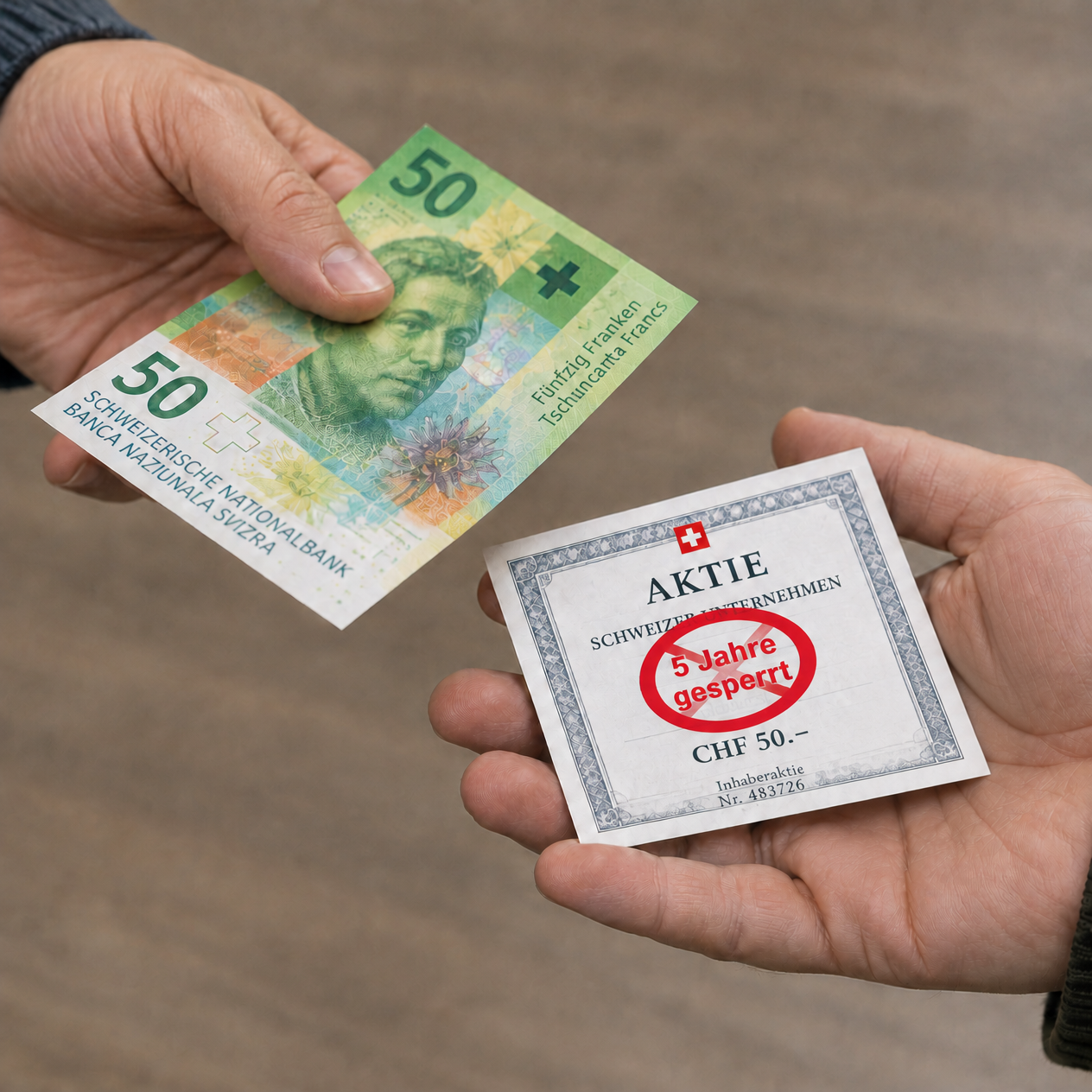
It’s a popular model in Switzerland, both for listed companies and SMEs: Employees give up part of their annual bonus in exchange for restricted shares. What should you pay attention to in practice? A few selected topics, presented briefly and clearly.
1) Restricted Employee Shares
These are actual shares with full voting and dividend rights immediately as of grant. The only limitation is that the shares cannot be sold during the lock-up period. If you leave the company, you can often keep your shares. This is the most common model in Switzerland. Other types, such as conditional share awards (restricted share units, RSUs) or actual shares with reverse vesting conditions, are common internationally but less frequent in Switzerland. This is partly due to tax considerations and partly due to concerns about legal enforceability in the event of a dispute.
2) Gross, net: What’s the conversion basis?
Here’s a strong recommendation from practical experience. Always use the following as the basis for the conversion:
- the actual bonus (not theoretical target bonus sizes) and
- the gross amount (not net).
Anything else quickly becomes complicated, for example, conceptually and/or tax-wise.
3) What portion of bonus?
What percentage of the actual gross bonus should be converted into shares? Many models range from 25% to 50%. With portions exceeding 50%, “dry tax” issues can arise if the restricted shares are taxed immediately upon allocation (as in Switzerland and some other countries) and the remaining cash portion of the bonus is insufficient to cover taxes on the entire package.
4) Mandatory or voluntary?
Both options occur in practice. Sometimes they are combined, for example, a minimum of 25% mandatory and 50% or more optional. In the Swiss context, it’s important to note: If employees have a choice, such choice should be made and documented in writing and bindingly before the end of the bonus-relevant year. For example, by December at the latest for the bonus payment (and conversion) in the following spring. The choice is therefore made at a time when the actual bonus amount is not yet known. This may not be ideal from a conceptual standpoint. However, otherwise, depending on cantonal practice, the tax authorities may no longer accept the tax discount for the lock-in period.
5) What is the conversion price?
A concrete example: The actual gross bonus amount is CHF 10,000, and the fair market value of the shares (for SMEs: tax value, e.g., calculated using a formula) is CHF 100. How many shares should be allocated?
- Option A: Conversion at full value. In the example above: CHF 10,000 divided by CHF 100 equals 100 shares. Advantage: No additional costs for the company (for providing the shares). Disadvantage: Less attractive for employees; and depending on cantonal practice, it may happen that the tax discount for the lock-up period is not accepted, and the full value must be taxed despite the lock-up period.
- Option B: Conversion at a reduced price, for example, after the applicable discount for the lock-up period according to Swiss tax regulations. For a share with a market value of CHF 100 and a 3-year lock-up period, this would mean a 16.038% lock-up period discount, resulting in a conversion to CHF 83,962 instead of CHF 100. This yields approximately 119 shares, instead of just 100 as in option A. Advantage: More attractive for employees, and the lock-up period discount for tax purposes should apply everywhere across Switzerland; that is, employees receive more shares without paying more taxes. Disadvantage: The costs for the company are higher (acquisition costs for more shares); and for board members or EC members in listed companies, this must also be reflected in the compensation report and covered by the total amount approved by the general meeting.
6) Duration of the lock-up period?
In practice, the most common timeframe is 3 to a maximum of 5 years. Less than 3 years may not adequately support the long-term nature of such models; and with more than 5 years, the model may lose its motivational impact because everything seems too intangible.
7) International taxation
With restricted shares (as described above), income tax is levied at different times: in some countries (such as Switzerland) immediately upon allocation of the shares; in others, only at the end of the restriction period. The company must take this into account for payroll and social security contributions. If a uniform timing for taxes, payroll, and social security contributions is a priority, restricted share units (RSUs) may need to be considered as an alternative.
[dialog]unlocked, November 2026